


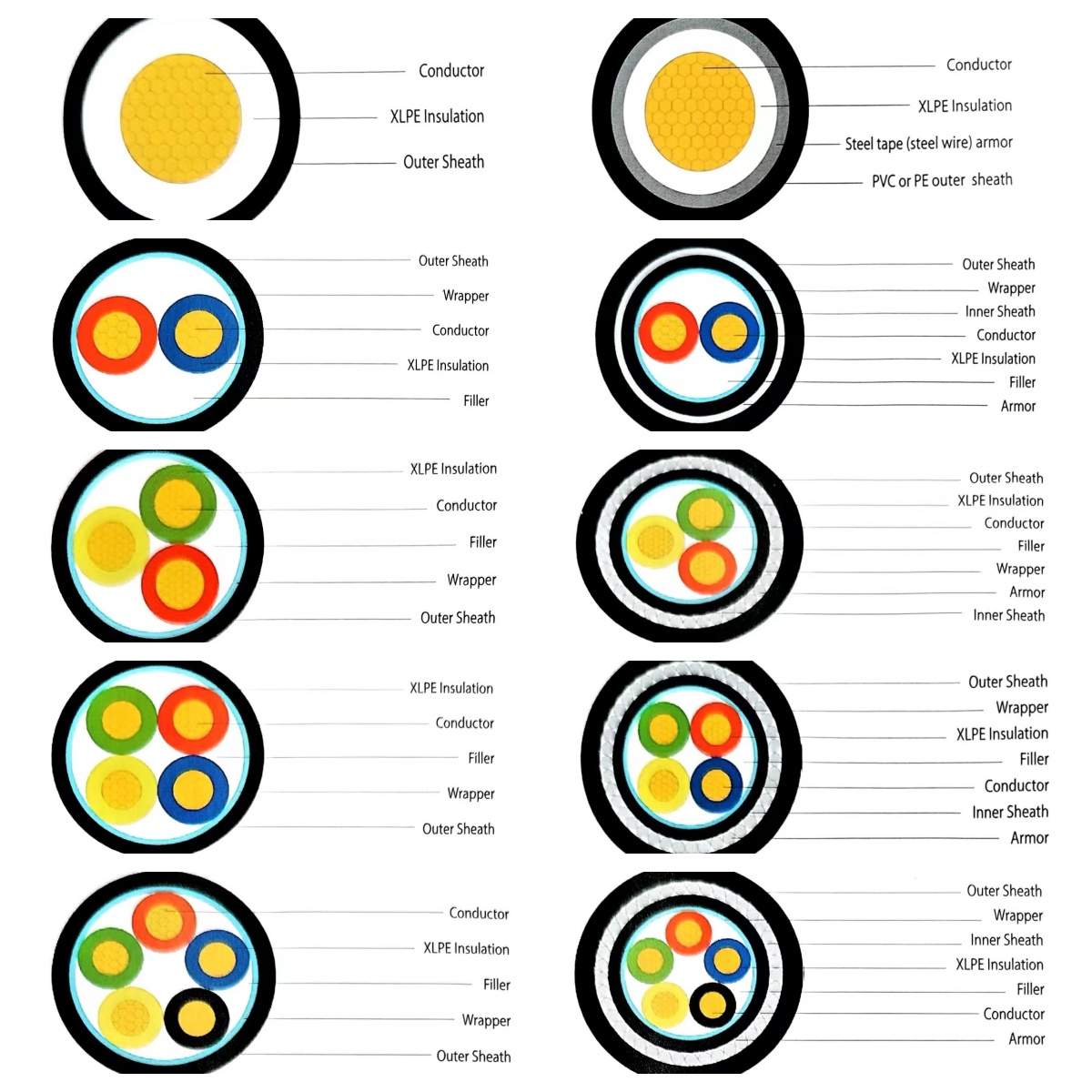
Conductor Material: The conductor of the cable is made of high - purity copper with a purity of more than 99.9%. High - purity copper has extremely low resistivity, which can efficiently conduct current, reduce energy loss during power transmission, and improve transmission efficiency. At the same time, pure copper has good ductility and plasticity, which can withstand a certain degree of bending and stretching during the production and laying of the cable, facilitating construction operations. In addition, pure copper has good chemical stability and is not easy to be corroded, which can ensure the long - term stability of the conductive performance of the conductor.
Insulation layer material: The insulation layer is made of cross - linked polyethylene (XLPE). XLPE is a polyethylene material treated by cross - linking, and its molecular structure forms a three - dimensional network structure. Compared with ordinary polyethylene, it has higher heat resistance. The long - term service temperature can reach 90℃, and the maximum temperature can reach 250℃ in case of short circuit, which can maintain stable insulation performance in a higher temperature environment. It has excellent anti - aging performance, can resist the influence of oxygen, ultraviolet rays, humidity and other factors, and prolong the service life of the cable. Moreover, XLPE has high insulation resistance, small dielectric loss and stable insulation performance, which can effectively prevent electric leakage and breakdown. At the same time, it has high mechanical strength, good impact resistance and tear resistance, and can protect the conductor from external mechanical damage.
Sheath material (if any): Some cables will be provided with a sheath outside the insulation layer. The sheath is usually made of polyvinyl chloride (PVC) or polyethylene (PE) materials. PVC Sheath has good corrosion resistance, weather resistance and mechanical strength, which can protect the cable from the erosion of the external environment, such as chemical substances, moisture and sunlight in the soil. PE sheath has better Flexibility and low - temperature resistance, is not easy to crack in cold environments, and is suitable for some special laying environments.
Style design: The cable is cylindrical as a whole with a compact structure. The appearance of single - core cable is simple, with only one layer of insulation layer (or plus sheath) wrapping the conductor; multi - core cable is made by stranding multiple Insulated Cores, and there may be filling materials and sheaths outside to ensure the roundness and structural stability of the cable. The color of the cable is usually black or gray, which has good dirt resistance and concealment, and can maintain a good appearance in different laying environments. At the same time, the color is also helpful to distinguish the type and use of the cable, facilitating construction and maintenance.
Conductor production: First, high - purity copper ingots are smelted to remove impurities, so as to obtain copper water that meets the purity requirements. Then, the copper water is cast into copper rods through continuous casting process, and the diameter of the copper rods is adjusted according to the specifications of the Cable Conductor. Next, the copper rod is drawn into Copper Wires of the required diameter by wire drawing process. During the wire drawing process, it is necessary to control the wire drawing speed, temperature and lubrication conditions to ensure the dimensional accuracy and mechanical properties of the copper wire. For multi - strand conductors, multiple copper wires are stranded according to a certain stranding method. Stranding can improve the flexibility and filling coefficient of the conductor, reduce the skin effect, and improve the conductive performance.
Insulation layer extrusion: The extrusion molding process is used to wrap the XLPE insulation layer outside the conductor. First, XLPE granular materials are added into the hopper of the extruder. After being heated and melted, the molten XLPE materials are transported to the mold through the screw of the extruder. The size of the mold is designed according to the specifications of the cable to ensure the uniform thickness of the insulation layer. During the extrusion process, it is necessary to accurately control the extrusion temperature (usually between 120 - 180℃), extrusion speed and pressure, so that the molten XLPE material can evenly coat the surface of the conductor to form a continuous insulation layer. After extrusion, the insulation layer needs to be cross - linked. The commonly used cross - linking methods include peroxide cross - linking, silane cross - linking and irradiation cross - linking. Peroxide cross - linking is to add peroxide cross - linking agent into XLPE material to make polyethylene molecules undergo cross - linking reaction at high temperature; silane cross - linking is to introduce silane coupling agent into polyethylene molecular chain, which undergoes cross - linking under the action of water and catalyst; irradiation cross - linking uses high - energy rays to make polyethylene molecules generate free radicals, and then undergo cross - linking reaction. Cross - linking treatment can significantly improve the heat resistance, mechanical properties and insulation performance of XLPE.
Cabling process (multi - core cable): For multi - core cables, it is necessary to cable multiple insulated cores. First, the insulated cores are stranded according to a certain stranding direction and pitch. The size of the stranding pitch will affect the flexibility and structural stability of the cable. During the stranding process, in order to ensure the roundness and filling rate of the cable, some inert materials, such as polypropylene rope, will be filled between the insulated cores. The filling material can also play a role in buffering and protecting the insulated cores, reducing the mutual friction and extrusion between the insulated cores during laying and use.
Sheath extrusion (if any): If the cable needs a sheath, the sheath extrusion is carried out after cabling. The sheath extrusion process is similar to the insulation layer extrusion. The sheath material (such as PVC, PE) is heated and melted, and then evenly coated on the outer layer of the cabled cable through the extruder mold. Control the extrusion parameters to ensure that the thickness of the sheath is uniform, the surface is smooth, and it is closely combined with the internal structure without defects such as bubbles and impurities.
Quality inspection: Strict quality inspection shall be carried out in each link of the production process. For the conductor, its diameter, resistivity, tensile strength and other parameters are tested; for the insulation layer, its thickness, insulation resistance, voltage resistance, thermal extension and other properties are tested; for the cabling and sheath links, their appearance, size, roundness and other aspects are tested. The finished cable also needs to undergo partial discharge test, aging test, tensile test, etc. to ensure that the product meets the relevant standards and technical requirements. Only the cables that pass all tests can leave the factory for sale.
Packaging materials: 0.6/1kV copper core XLPE power feeder cables are usually packaged with cable reels. There are two types of cable reels: wooden cable reels and steel cable reels. Wooden cable reels are made of high - quality hardwood, which has certain strength and toughness, can bear the weight of the cable, and has relatively low cost, so it is suitable for transportation and storage in general occasions. Steel cable reels are made of steel by welding, which have higher strength and stronger bearing capacity. They are suitable for packaging large - length and large - specification cables, as well as long - distance transportation and multiple turnover uses.
Packaging method: The cable is neatly wound on the cable reel. During winding, it is necessary to ensure that the cable is arranged tightly and flatly without distortion, crossing and overlapping, so as to prevent the cable from being damaged during transportation and storage. A layer of plastic film is wrapped around the outer layer of the cable, which has the functions of moisture proof and dust proof, and can protect the cable from pollution by the external environment. For wooden cable reels, baffles are added on the side of the cable reel to prevent the cable from sliding off from the side. A shaft sleeve is installed at the central shaft hole of the cable reel to facilitate the handling and installation of the cable reel.
Packaging marks: The relevant information of the product is clearly marked on the side and end face of the cable reel, including product name, model specification, length, rated voltage, execution standard, production date, production batch number, manufacturer's name, address, contact information, etc. These marks should be clear and firm, not easy to fall off, so as to facilitate users to identify and check product information, and also conducive to product traceability and management.
Transportation mode: Different transportation modes can be selected according to the quantity, specification, transportation distance of the cable and customer requirements. Road transportation has the characteristics of high flexibility and door - to - door service, which is suitable for medium - and short - distance transportation and small - batch cable transportation. Railway transportation has large transportation volume, low cost and good stability, which is suitable for long - distance transportation and large - batch cable transportation. For urgent orders or small batches of samples, air transportation can also be used to shorten the transportation time, but the cost of air transportation is relatively high.
Transportation precautions: Before transportation, check the packaging of the cable to ensure that the packaging is intact and firm, and the cable reel is not damaged. During transportation, the cable reel should be placed horizontally to avoid tilting, inverting or stacking, so as to prevent the cable reel from rolling and colliding, which may cause damage to the cable. The transport vehicle should drive smoothly, avoid violent actions such as sudden braking and sharp turning, and reduce the shaking of the cable reel. At the same time, measures should be taken to prevent rain, sun and moisture, so as to avoid the cable being soaked by rain, exposed to the sun or damp. When loading and unloading cables, special lifting equipment, such as cranes and forklifts, should be used. During loading and unloading, light loading and unloading should be carried out to avoid impact and damage to the cable and cable reel.
Transportation fixation: In order to prevent the cable reel from moving and rolling during transportation, it is necessary to fix it. Steel wire ropes, iron chains, etc. can be used to fix the cable reel on the carriage of the transport vehicle. The fixed points should be selected at the solid parts of the cable reel to ensure firm and reliable fixation. For long - distance transportation, buffer materials, such as wooden boards and rubber pads, can be placed between the cable reels to reduce mutual collision.
Delivery process: After the customer places an order and pays, the sales department will transmit the order information to the warehouse and production department. Warehouse personnel prepare goods according to the order information. If they are stock products, they need to check whether the model specification and quantity of the products are consistent with the order; if they are customized products, after the production department completes the production, the quality inspection department will inspect them, and then transfer them to the warehouse after passing the inspection. After packaging the products, the warehouse personnel contact the transportation company to determine the transport vehicle and transportation time. Before delivery, the delivery information (such as the name of the transportation company, license plate number, waybill number, estimated arrival time, etc.) is informed to the customer to facilitate the customer to prepare for receiving the goods.
Delivery time: For conventional specification cables in stock, delivery is generally completed within 1 - 3 working days after receiving the order and confirming payment. For customized specification cables, the delivery time is determined according to the production cycle, usually 7 - 15 working days. The specific delivery time will be communicated and confirmed with the customer in advance to ensure that the customer knows the progress of the goods.
Delivery tracking: After the cable is delivered, the company will track the transportation status of the goods. Keep close contact with the transportation company to timely understand the location and transportation progress of the goods. If there are abnormal situations during transportation, such as traffic jams and weather effects, which lead to transportation delays, the customer will be informed in a timely manner, and active coordination will be made to solve the problem to ensure that the goods can be delivered to the customer as soon as possible.
Sample provision: In order to enable customers to better understand the quality and performance of the product, the company can provide samples for customers. Customers can choose samples of the required specifications according to their own needs. The length of the sample is generally 1 - 2 meters, which can meet the customer's inspection of the appearance, structure and material of the cable.
Sample cost: The sample itself is provided free of charge, but the customer needs to bear the express fee of the sample. For large customers with clear cooperation intention or long - term partners, the company can reduce or exempt the express fee of the sample according to the actual situation to promote the cooperation.
Sample delivery: After receiving the customer's sample demand, the company will prepare
Quality assurance: The company promises that the 0.6/1kV copper core XLPE power feeder cables produced and sold comply with relevant national standards and industry norms, and the product quality guarantee period is 1-3 years. During the quality guarantee period, if the cable has quality problems caused by non-human factors, such as aging of the insulation layer and conductor breakage, the company will provide free repair or replacement services for the customer.
Technical support: The company has a professional technical team to provide customers with comprehensive technical support. If customers encounter technical problems during the installation and laying of cables, they can consult at any time by phone, email, etc., and the technical personnel will give timely answers and guidance. For complex technical problems, the company can arrange technical personnel to go to the site for guidance and assistance to ensure the installation quality of the cable.
Fault handling: If the customer finds that the cable is faulty during use, they should notify the company in a timely manner. After receiving the notice, the company will respond within 24 hours, arrange professional personnel to understand the fault situation, and formulate a solution. For faults that need on-site handling, personnel will be arranged to rush to the site for repair or replacement as soon as possible to minimize the customer's losses.
Customer feedback: The company attaches great importance to customers' feedback and has set up special customer feedback channels, such as customer service phone, email, online message, etc. Customers can feedback any problems or suggestions encountered during the use of the product through these channels. The company will timely handle and reply to customers' feedback, and continuously improve product quality and service level according to customers' feedback.


Hongtai Cable Technology Co., Ltd
E-mail: export@qlcables.com
sales@qlcables.com
Tel/whatsapp:+86-18032066271
Tambahkan : Zona Pengembangan Industri Xiaokou, Kabupaten Ningjin, Kota Xingtai , Provinsi Hebei, Cina
Hak Cipta © Hongtai Cable Technology Co., Ltd Dukungan Teknis:Teknologi Ronglida
Situs web ini menggunakan cookie untuk memastikan Anda mendapatkan pengalaman terbaik di situs web kami.
 English
 Español
 Portugues
 Pусский
 Français
 العربية
 ไทย
ไทย Türk dili
 Tiếng Việt



 Telepon
 Surat
Surat